Cabinets shape how a kitchen looks and works every day, and they often take a large share of the budget. Whether you are starting a remodel or building a new home, the choice between custom and stock cabinets is one of the biggest decisions you will make. Neither option suits every home. The right pick depends on your budget, your timeline, and the design you want. Cabinets also work best when they match the wider plan for the room, so it helps to see how they fit into kitchen renovations as a whole. This guide compares custom and stock cabinets in plain words so you can choose with confidence.
What Are Stock Cabinets?
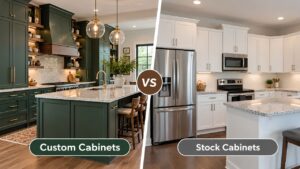
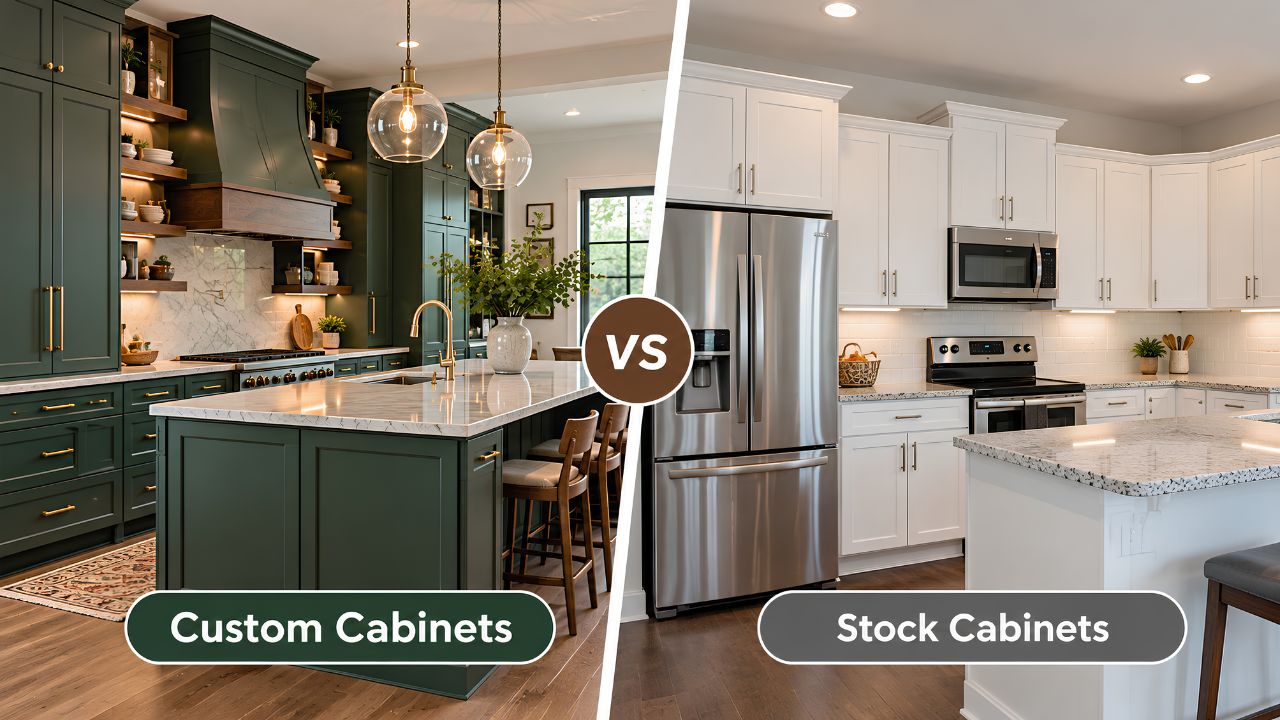
Stock cabinets are built in a factory in set sizes and kept ready to ship. You choose from a short list of door styles and colors. Some arrive fully assembled, while others are ready-to-assemble (RTA) and come flat-packed.
The main limit is size. Stock widths usually rise in steps of about three inches. If your wall does not match, installers add filler strips to close the gap. In a plain, square room this is hardly noticeable. In a room with odd corners or uneven walls, the fillers can look out of place.
Pros of stock cabinets:
- Low price: They are the most budget-friendly choice.
- Fast delivery: Most are ready to ship, so your project is not held up.
- Simple installation: Standard sizes make fitting easier and quicker.
- Easy to replace: A damaged door or box is simple to match and swap.
Cons of stock cabinets:
- Fixed sizes: Odd spaces may need fillers or gaps.
- Limited choice: You pick from the maker’s set colors and styles.
- Uneven quality: Build quality changes a lot between brands.
What Are Custom Cabinets?
Custom cabinets are made from scratch for your room. A cabinetmaker measures the space and builds each piece to your plan. You decide the size, wood, door style, finish, and hardware. Because nothing starts from a standard design, custom cabinets can handle tricky spots such as sloped ceilings, columns, and old walls that are not straight.
This made-to-fit approach is also common in commercial construction projects, where counters and storage are planned around the exact needs of shops and offices.
Pros of custom cabinets:
- Perfect fit: Every piece is sized for your room, with no filler strips.
- Better materials: Makers can use solid wood or thick plywood with strong joints.
- Full design control: You choose the size, wood, finish, and hardware.
Cons of custom cabinets:
- High price: They cost several times more than stock.
- Long wait: They are built after you order.
- No returns: Made-to-order cabinets usually cannot be sent back.
Cost Comparison
As a rough guide, many US cost guides put stock cabinets at about $60 to $200 per linear foot and custom cabinets at about $500 to $1,200 or more. Prices change by region, brand, and year, so treat these numbers as a starting point and get local quotes.
Cabinet type is only one part of the cost. Material, size, finish, door style, and hardware all matter. Extras such as pull-out shelves, spice racks, and built-in lighting add to the total. Delivery, installation, and countertops are usually separate items.
A good way to compare is to ask each supplier for a full written quote that lists what is included. If you choose stock, you can also lift the look for little money by painting the doors or swapping the handles for better hardware.
Quality and Materials
Many stock cabinets use particleboard or MDF for the boxes, often with a laminate or thin veneer finish. These materials cost less, but they can swell if water sits on them. Custom makers can use solid wood or thick plywood with strong joints, and solid wood can be sanded and refinished later.
Quality varies by brand in both groups, and some stock lines are built better than some custom work. Do not judge by type alone. Use this checklist on any cabinet you consider:
- Plywood boxes instead of thin particleboard
- Shelves at least ¾ inch thick
- Soft-close hinges and drawer slides
- A strong, solid back panel
- Third-party certification, such as KCMA, where it is offered
Design and Style Options
Stock cabinets come in a small set of safe colors, such as white, grey, and wood tones, with only a few door styles. This is enough for a clean, simple kitchen, and you can change the look later with paint or new handles. The limit is that you must pick from what the maker already sells.
Custom cabinets remove that limit. You can match an existing color, mix finishes, add special trim, or copy a style from an older part of the house. If you already have a clear design idea, custom cabinets let you build it without compromise. If you are happy with a standard look, stock cabinets give you a similar clean result for much less money.
Storage and Organization
Stock cabinets give you basic shelves and drawers in fixed sizes, and many lines let you add pull-outs or dividers. This works well for everyday cooking, but tall baking sheets, big pots, or small appliances may not fit neatly into set sizes.
Custom cabinets let you plan storage around the way you cook. You can add a tall slot for baking sheets, a drawer sized for your biggest pot, or a nook for small appliances. So if your storage needs are simple, stock cabinets are usually enough. If you have special items to store, custom cabinets will use the space better. Write down what you use most before you meet any supplier.
Lead Time and Delivery
Stock cabinets are made ahead of time, so they can arrive in days to two weeks. Custom cabinets are built only after you order, so they usually take about 6 to 12 weeks or more. Wait times vary by maker, so ask for a written delivery date before you order.
Time matters because a late delivery can hold up the plumber, the electrician, and the countertop installer. If your timeline is tight, stock cabinets are the safer choice. If you choose custom, order as soon as the layout is final, and confirm every measurement first because made-to-order cabinets usually cannot be returned.
Installation
Stock cabinets are made for simple installation, and some homeowners fit them on their own. Even then, you need a level guideline, solid fixing into wall studs, and extra hands, because full cabinet boxes are heavy. Fillers are also cut and fitted on site to close any gaps.
Custom cabinets are built to your exact measurements, so they fit more tightly, but they usually need an experienced installer. Walls and floors are rarely perfectly straight, and small adjustments are made on site. If you hire a team, it helps to know the questions to ask a general contractor before you sign anything.
Can You Combine Both?
Yes, and it is a smart way to balance cost and fit. Use stock cabinets for the straight, standard runs of the kitchen. Then add custom cabinets only where fit matters most, such as a tall pantry, a corner unit, or a section under a sloped ceiling. Keep the door style and finish the same across both so the room looks like one design.
How to Choose Between Custom and Stock Cabinets
Choose stock when: your budget is tight, your timeline is short, your room is square, and a standard style is fine.
Choose custom when: your layout is awkward, you want exact storage, you want a one-of-a-kind look, or you plan to stay in the home for many years.
Think about a mix when: most of your kitchen is standard but one or two spots need a perfect fit.
Also avoid common errors, such as ordering before the final measurements or choosing on price alone. Most of these problems begin with weak planning, and this list of common construction planning mistakes shows what to watch for.
Conclusion
There is no single winner between custom and stock cabinets. Stock suits simple rooms and tight budgets, and custom gives the most control over fit, quality, and style. Measure your space, set a firm budget, and think about how you use your kitchen each day. If you are planning a full kitchen remodeling project, decide on your cabinets early because they affect the rest of the schedule. For more planning help, you can browse the guides on the Man Made Builders website.
Frequently Asked Questions
1. What is the difference between custom and stock cabinets?
Stock cabinets are made in standard sizes and styles and kept ready to ship. Custom cabinets are designed and built for your exact space, so you control the size, material, and finish.
2. How much more do custom cabinets cost than stock cabinets?
Custom cabinets often cost several times more than stock cabinets, especially with solid wood, special finishes, and built-in features. Compare full written quotes, including delivery and installation.
3. Are custom cabinets worth it?
Custom cabinets can be worth the investment for kitchens with unusual layouts, specific storage needs, or unique design preferences. For simple kitchens, stock cabinets may offer better value.
4. Are stock cabinets low quality?
Not always. Quality depends on the brand and materials used. Check for sturdy cabinet boxes, thick shelves, durable hinges, and well-built drawer slides before buying.
5. Can I mix custom and stock cabinets in one kitchen?
Yes. You can use stock cabinets for standard areas and add custom cabinets where a precise fit or specialized storage is needed, helping balance cost and functionality.